Subjects / Mathematics
Handwritten mathematics, step by step
From scanned working to feedback in Canvas. Lectora drafts against your marking guidance; you review the method, notation and reasoning.
Illustrative assessment example
Fictional work and authored feedback, shown to explain the workflow.
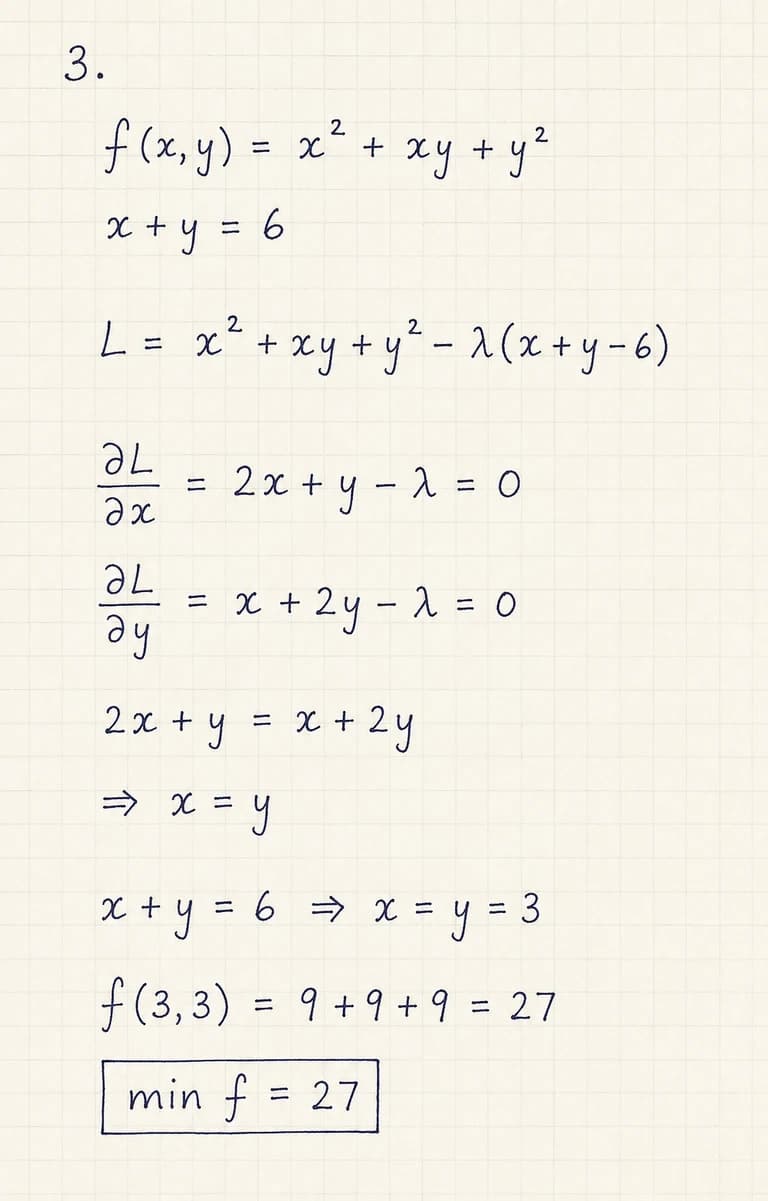
Read the handwriting as text
f(x, y) = x² + xy + y²; x + y = 6.
L = x² + xy + y² − λ(x + y − 6).
∂L/∂x = 2x + y − λ = 0; ∂L/∂y = x + 2y − λ = 0.
2x + y = x + 2y ⇒ x = y. x + y = 6 ⇒ x = y = 3.
f(3, 3) = 9 + 9 + 9 = 27. min f = 27.
Explore the example
Start with the method
The student uses a Lagrange multiplier to account for the constraint x + y = 6.
- Example marking criterion
- Formulate the constrained optimisation problem.
Example feedback for review
Your Lagrangian includes both the objective and the constraint. This gives you a sound starting point for the calculation.
You check the reading, the reasoning and the proposed assessment.
What should the working demonstrate?
Your assessment criteria can distinguish the approach from the final answer. These are examples of what to specify in the marking guidance.
Method and intermediate steps
Specify which steps demonstrate understanding and when a sound method merits partial credit despite a calculation error. The examiner checks the proposed points against the actual working.
Notation and equivalent expressions
State which answer forms and notation are acceptable. Clear scans help preserve the distinctions between symbols; any uncertain reading needs checking against the original.
Proof and justification
Ask for assumptions, a connected argument and a justified conclusion. Use the feedback draft to support your review of those criteria, with the submitted proof in view.
From submitted work to a draft you can review
How Lectora reads the documentsProvide the work
Bring the submissions, assignment and examiner guidance into the assessment.
Read in context
Lectora works with supported files and relevant available course material.
Draft the assessment
A proposed score and written feedback give you a starting point for review.
Review and publish
You check and edit. A qualified examiner approves each grade before it reaches Canvas.
Questions from educators
Bring your mathematics assessment
Explore how your assignment, marking guidance and submission formats fit the review process in Canvas.
Request accessThe example is illustrative. Read the separate mathematics case for the study's findings and limits.
Read the pilot story and its status