DOCUMENTS
Document understanding
Handwritten work, tables, graphs and written reasoning can all inform an assessment. Lectora uses submitted files and your guidance to draft scores and feedback. You review the draft against the original work.
Three kinds of work. The same need for context.
Illustrative assessment example
Fictional work and authored feedback, shown to explain the workflow.
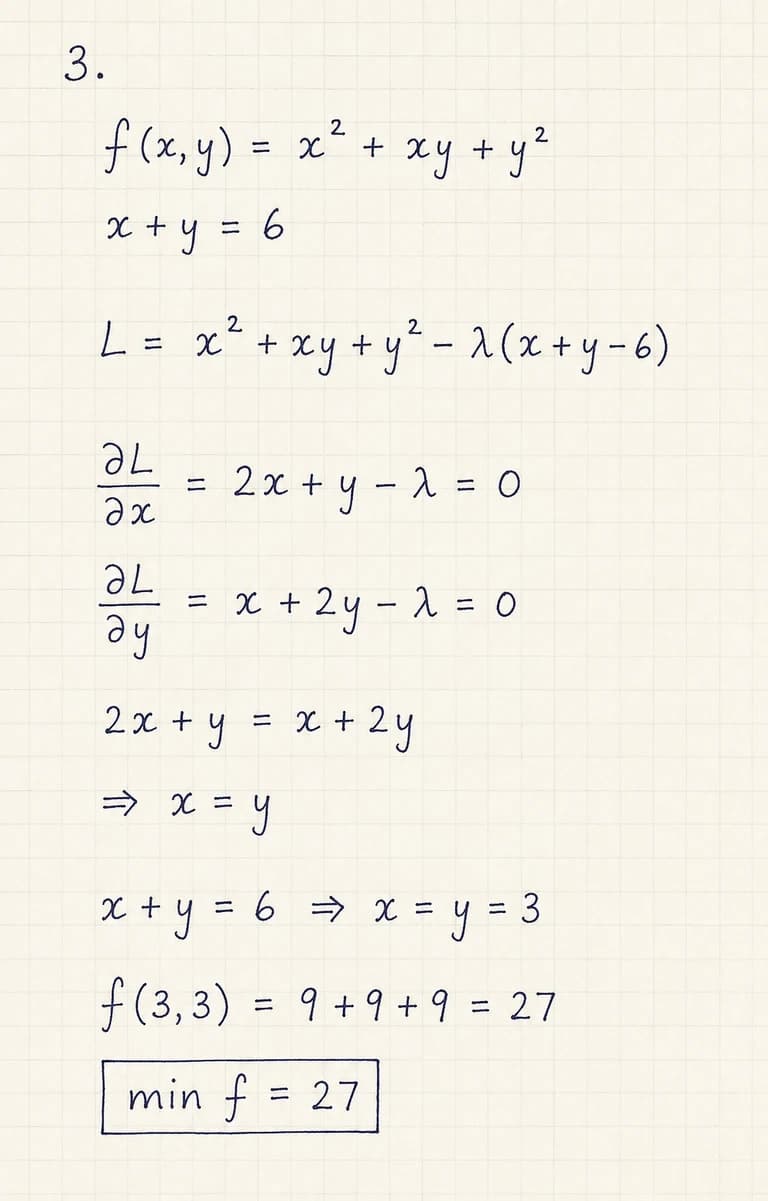
Read the handwriting as text
f(x, y) = x² + xy + y²; x + y = 6.
L = x² + xy + y² − λ(x + y − 6).
∂L/∂x = 2x + y − λ = 0; ∂L/∂y = x + 2y − λ = 0.
2x + y = x + 2y ⇒ x = y. x + y = 6 ⇒ x = y = 3.
f(3, 3) = 9 + 9 + 9 = 27. min f = 27.
Explore the example
Start with the method
The student uses a Lagrange multiplier to account for the constraint x + y = 6.
- Example marking criterion
- Formulate the constrained optimisation problem.
Example feedback for review
Your Lagrangian includes both the objective and the constraint. This gives you a sound starting point for the calculation.
You check the reading, the reasoning and the proposed assessment.
Student submissions and course material have different roles
A submission is the work being assessed. Course material supplies context: the definitions, methods and explanations your course uses. Keeping those roles clear helps you judge whether a draft responds to the student's actual answer.
In the grading workflow, Lectora receives the submitted files, with preparation appropriate to their format. PDFs and images can carry scanned pages and handwritten work; Word documents and spreadsheets carry other kinds of written and numerical work.
Course material is indexed separately into searchable passages. PDFs and images use optical character recognition (OCR) to extract text. Other supported documents are read according to their format. Relevant excerpts can then support grading, question drafting and source lookup.
OCR and visual reading provide evidence to check
OCR recognizes text on a page. Visual interpretation can add context from a figure, diagram or image. Together they can make more of a document available to the assessment workflow, including material that is not ordinary typed prose.
Neither is a guarantee of a faithful reading. A faint minus sign, a handwritten subscript or an annotation beside a graph may change the meaning. When a draft depends on that detail, compare it with the original page.
The examples above are illustrative course-assessment material. They show the kinds of evidence an examiner might inspect, rather than measured extraction accuracy.
Formulas, tables and graphs need their surrounding context
A formula needs its symbols and intermediate steps. A table needs its headings and units. A graph needs its axes, scale and the explanation that accompanies it. Those details help distinguish a correct result from sound reasoning.
Supply the relevant assignment instructions, solution and examiner guidance alongside the work. For a spreadsheet, review the calculation and its interpretation, not just the value displayed in a cell. Document support does not establish that every embedded chart or equation survives every file format unchanged.
Your assessment guidance governs the draft
Lectora drafts against the rubric and selected assignment, solution and examiner files. These take priority over supporting course excerpts. The course's learning goals have a separate role in question drafting and assessment coverage; they do not replace your grading criteria.
Relevant passages from indexed material can provide context, with source and page information when available. That is a way to inspect supporting evidence, not a claim that every document has been read in full for each submission.
Review the reading as well as the proposed score
Check that the draft addresses the student's work, recognizes the steps that matter and applies the intended criteria. Edit or reject a draft when the reading or the assessment is wrong. A qualified examiner decides the grade and chooses what to publish to Canvas.
Lectora's published validation concerns score agreement on long-form written exams. It does not establish handwriting recognition rates, chart-reading accuracy or mathematical proof checking. Use a pilot with representative material from your course to see which drafts are useful and which details need closer review.